
 From Phones to Glasses: The Next Evolution of AR Content Creation
From Phones to Glasses: The Next Evolution of AR Content Creation
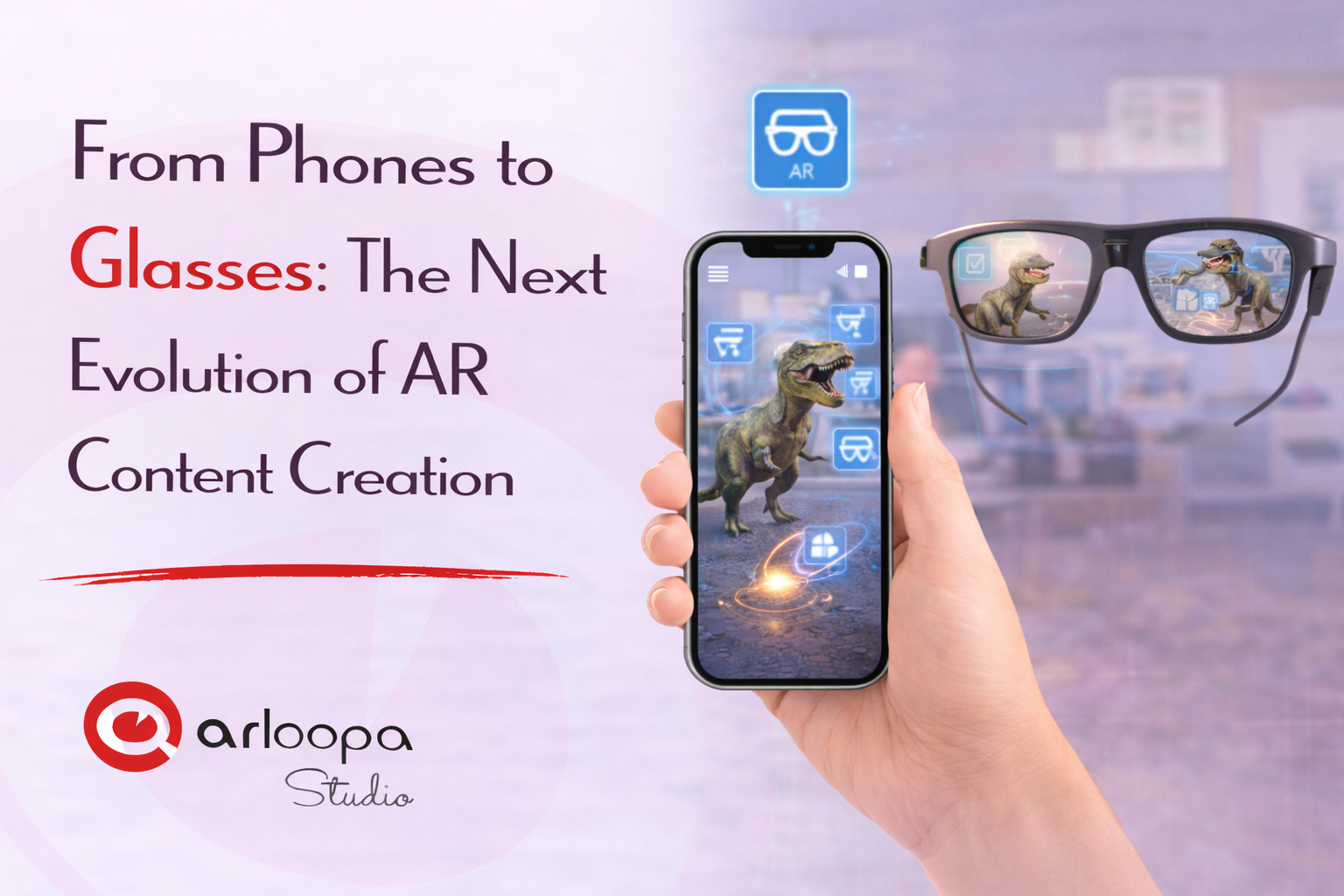
Augmented Reality (AR) has already transformed how we interact with digital content - from face filters to interactive brand experiences. But the biggest shift is still ahead. As AR glasses move from concept to mainstream, we’re entering a new era where AR is no longer something you open on your phone - it’s something you live inside.
For creators and brands, this means one thing: AR content creation is about to fundamentally change.
In this article, we’ll explore how AR is evolving from mobile-first experiences to wearable, always-on environments - and how you can start preparing with ARLOOPA Studio.
The Shift: From Handheld to Hands-Free AR
Until now, most AR experiences have been tied to smartphones. Users needed to:
- Open an app
- Point their camera
- Engage for a limited time
With AR glasses, that friction disappears.
What changes:
- AR becomes instant and always accessible
- No need to hold a device
- Digital content blends seamlessly into everyday life
Instead of launching AR, users will simply see it.
This shift is as significant as the move from desktop to mobile - and it opens the door to entirely new types of experiences.
Always-On AR: A New User Behavior

AR glasses introduce the concept of always-on AR, where digital layers exist continuously in the user’s environment.
Examples of everyday AR with glasses:
- Navigation arrows appearing directly on the road
- Real-time translations floating over text
- Product information appearing instantly in stores
- Notifications integrated into your surroundings
This means AR is no longer a “feature” - it becomes a core layer of reality.
For creators, this changes the goal from building experiences people visit to designing experiences people live with.
Designing for AR Glasses: What Must Change
Creating AR for glasses is very different from designing for phones.
Key shifts in design:
1. Simplicity over complexity
Users won’t tolerate clutter in their field of vision. Clean, minimal design is essential.
2. Spatial thinking
Content must exist naturally in 3D space — anchored to surfaces, objects, and locations.
3. Context-aware interactions
AR should respond to where the user is and what they’re doing.
4. Short, seamless interactions
Micro-experiences will outperform long, app-like sessions.
In short: less tapping, more existing.
From Experiences to Environments

With smartphones, AR experiences are often isolated moments. With glasses, they become persistent environments.
What this unlocks:
- Rooms that transform into themed spaces
- Virtual objects that stay in place over time
- Interactive storytelling happening around the user
- Digital layers that evolve and respond
This is where AR shifts from content to world-building.
The Role of ARLOOPA Studio in the Glasses Era
Even though AR glasses are still emerging, creators don’t have to wait. Tools like ARLOOPA Studio already allow you to build the foundation for this future.
What you can start creating today:
- Persistent AR scenes
Design experiences that stay anchored in real-world locations - Lightweight 3D assets
Optimize models for fast, seamless rendering - Spatial interactions
Place content in real environments instead of flat screens - Utility-driven AR
Create helpful overlays (education, tourism, retail)
By focusing on these principles now, your content will be ready for the transition to AR glasses.
New Opportunities for Brands and Creators
The move to AR glasses will unlock entirely new opportunities:
- AR commerce: Try products instantly in your environment
- Location-based storytelling: Experiences tied to real places
- Interactive advertising: Non-intrusive, contextual brand presence
- Education & tourism: Real-time, immersive learning layers
The key difference?
Users won’t search for these experiences - they’ll encounter them naturally.
Challenges to Consider
This new era also comes with responsibilities:
- Avoiding visual overload
- Respecting user privacy
- Designing non-intrusive experiences
- Ensuring accessibility and comfort
The best AR content will feel invisible yet valuable.
The transition from phones to AR glasses marks the beginning of a new chapter in digital interaction. AR is no longer just an add-on - it’s becoming a seamless extension of reality.
For creators, this is a rare moment: a chance to define how people will experience the world in the years ahead.
By starting now with tools like ARLOOPA Studio, you’re not just creating AR content - you’re shaping the future of how reality itself is experienced.


See more articles



Solutions