
 How AI is Enhancing WebAR Experiences in 2026
How AI is Enhancing WebAR Experiences in 2026
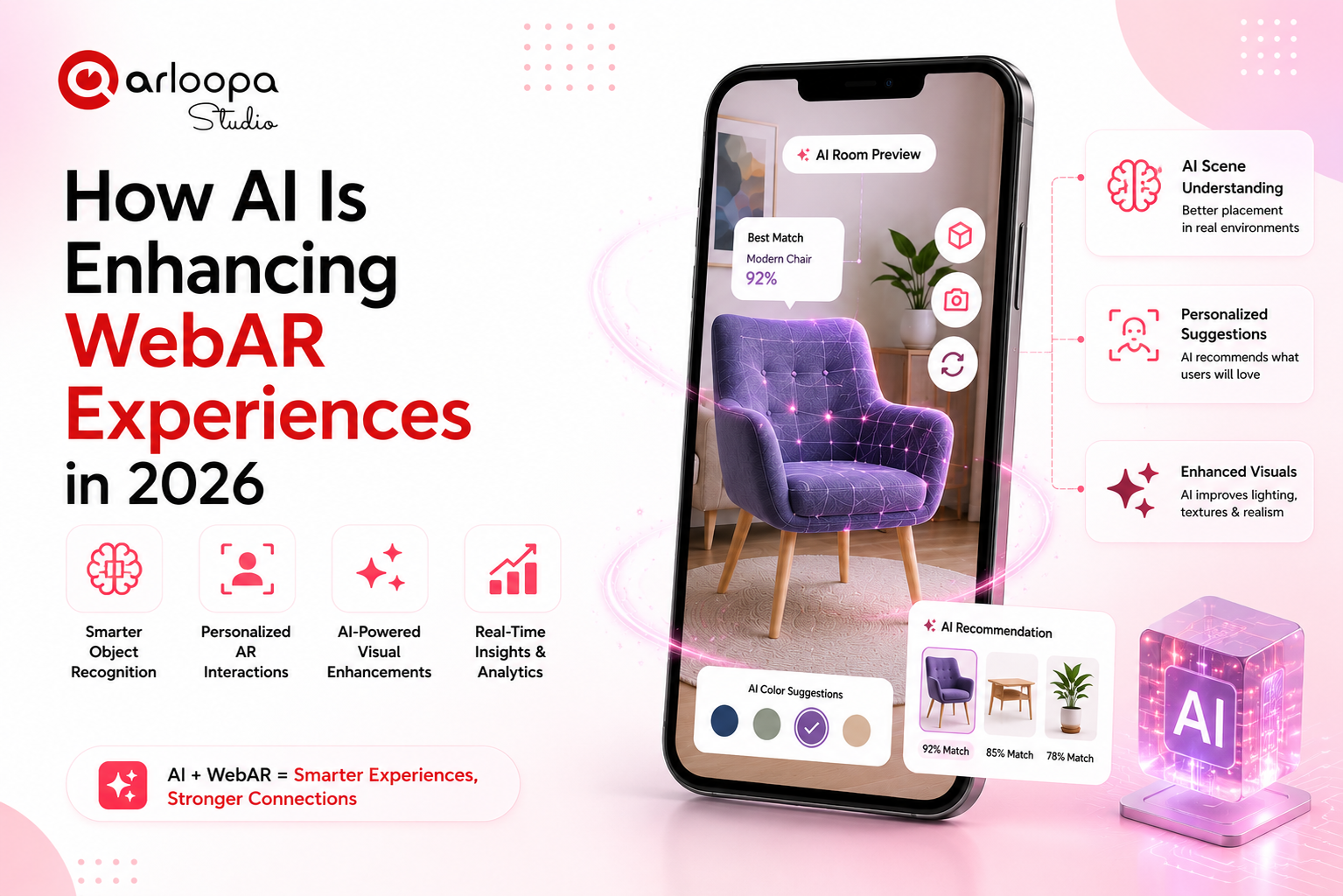
WebAR has already transformed how businesses deliver augmented reality experiences by making them accessible directly through a mobile browser - no app download required. At the same time, artificial intelligence (AI) is reshaping how digital content is created, personalized, and optimized.
When these two technologies come together, they unlock a new generation of intelligent, interactive, and highly scalable experiences.
From automated 3D content creation to personalized product recommendations and conversational virtual assistants, AI is making WebAR faster to build, more engaging for users, and more effective for businesses.
With ARLOOPA Studio, companies can combine AI and WebAR to create immersive experiences that drive measurable results across marketing, ecommerce, education, and customer engagement.
What Happens When AI Meets WebAR?
WebAR provides the immersive interface. AI adds intelligence.
Together, they enable experiences that can:
- Adapt to user preferences in real time
- Generate or optimize 3D assets
- Recognize objects and environments
- Provide personalized recommendations
- Support voice-based interactions
- Analyze user behavior to improve performance
The result is a more dynamic and relevant augmented reality experience.
1. AI-Powered 3D Content Creation
One of the most time-consuming parts of WebAR development is creating 3D assets.
AI tools can accelerate this process by:
- Generating 3D models from images or text prompts
- Upscaling textures
- Retopologizing models
- Reducing polygon counts automatically
This shortens production timelines and lowers development costs.
2. Personalized WebAR Experiences
AI can analyze user behavior, location, and preferences to customize content.
For example:
- Ecommerce shoppers see recommended products in AR
- Tourists receive personalized information based on interests
- Event attendees unlock tailored experiences
Personalization increases engagement and conversion rates by making content more relevant.
3. Intelligent Virtual Try-On
AI improves virtual try-on experiences by enhancing face tracking, body detection, and fit recommendations.
This is particularly useful for:
- Cosmetics
- Eyewear
- Jewelry
- Fashion accessories
Customers receive a more realistic and accurate preview before making a purchase.
4. Conversational AR Assistants
AI-powered assistants can be integrated into WebAR experiences to answer questions and guide users.
Examples include:
- Product advisors in ecommerce
- Museum guides
- Real estate assistants
- Training instructors
These assistants create more interactive and informative experiences.
5. Smarter Object and Scene Recognition
AI enhances the ability of WebAR systems to recognize real-world objects and environments.
Applications include:
- Automatically detecting products and launching relevant content
- Identifying landmarks in tourism experiences
- Recognizing educational materials
This makes interactions more seamless and context-aware.
6. Predictive Analytics and Optimization
AI can analyze performance data from WebAR campaigns to identify patterns and recommend improvements.
Metrics may include:
- Session duration
- Interaction rates
- Conversion events
- Drop-off points
These insights help businesses refine experiences and maximize ROI.
7. Automated Localization and Content Adaptation
AI translation and localization tools make it easier to deliver WebAR experiences to global audiences.
Content can be adapted into multiple languages and tailored to different markets more efficiently.
8. Voice-Controlled AR Experiences
Natural language processing enables users to interact with WebAR using spoken commands.
Examples include:
- “Show me this product in black.”
- “Explain how this feature works.”
- “Take me to the next exhibit.”
Voice interaction improves accessibility and creates a more intuitive experience.
Industries Benefiting from AI-Enhanced WebAR
AI and WebAR are creating new opportunities in:
- Retail and ecommerce
- Real estate
- Education
- Tourism
- Healthcare
- Manufacturing
- Events and entertainment
Across these industries, businesses are using intelligent AR experiences to deliver more personalized and impactful interactions.
Why This Combination Matters for Businesses
The combination of AI and WebAR offers significant advantages:
- Faster content creation
- Lower production costs
- Better personalization
- Improved user engagement
- Stronger analytics
- Higher conversion rates
These benefits make immersive technology more scalable and accessible.
How ARLOOPA Studio Combines AI and WebAR
ARLOOPA Studio develops advanced WebAR solutions that incorporate AI-driven capabilities for businesses across industries.
Services include:
- Product visualization
- Virtual try-on
- Interactive packaging
- Personalized experiences
- Analytics integration
- Custom AR development
Whether you want to automate 3D creation, personalize customer journeys, or build intelligent immersive campaigns, ARLOOPA Studio can help.
The Future of Intelligent Immersive Experiences
In 2026, AI is turning WebAR from a static visual experience into an adaptive and intelligent digital platform.
As both technologies continue to evolve, businesses will be able to deliver richer, faster, and more personalized interactions at scale.
Organizations that embrace AI-enhanced WebAR today are positioning themselves at the forefront of digital innovation.
Ready to Build Smarter WebAR Experiences?
If you want to combine the power of artificial intelligence and browser-based augmented reality, ARLOOPA Studio can help you create immersive experiences that engage customers and deliver measurable results.
Transform your products, packaging, and campaigns with intelligent WebAR solutions.


See more articles



Solutions