



 The Ultimate Guide to AR Marketing: How Brands Create Interactive Customer Experiences That Drive Results
The Ultimate Guide to AR Marketing: How Brands Create Interactive Customer Experiences That Drive Results
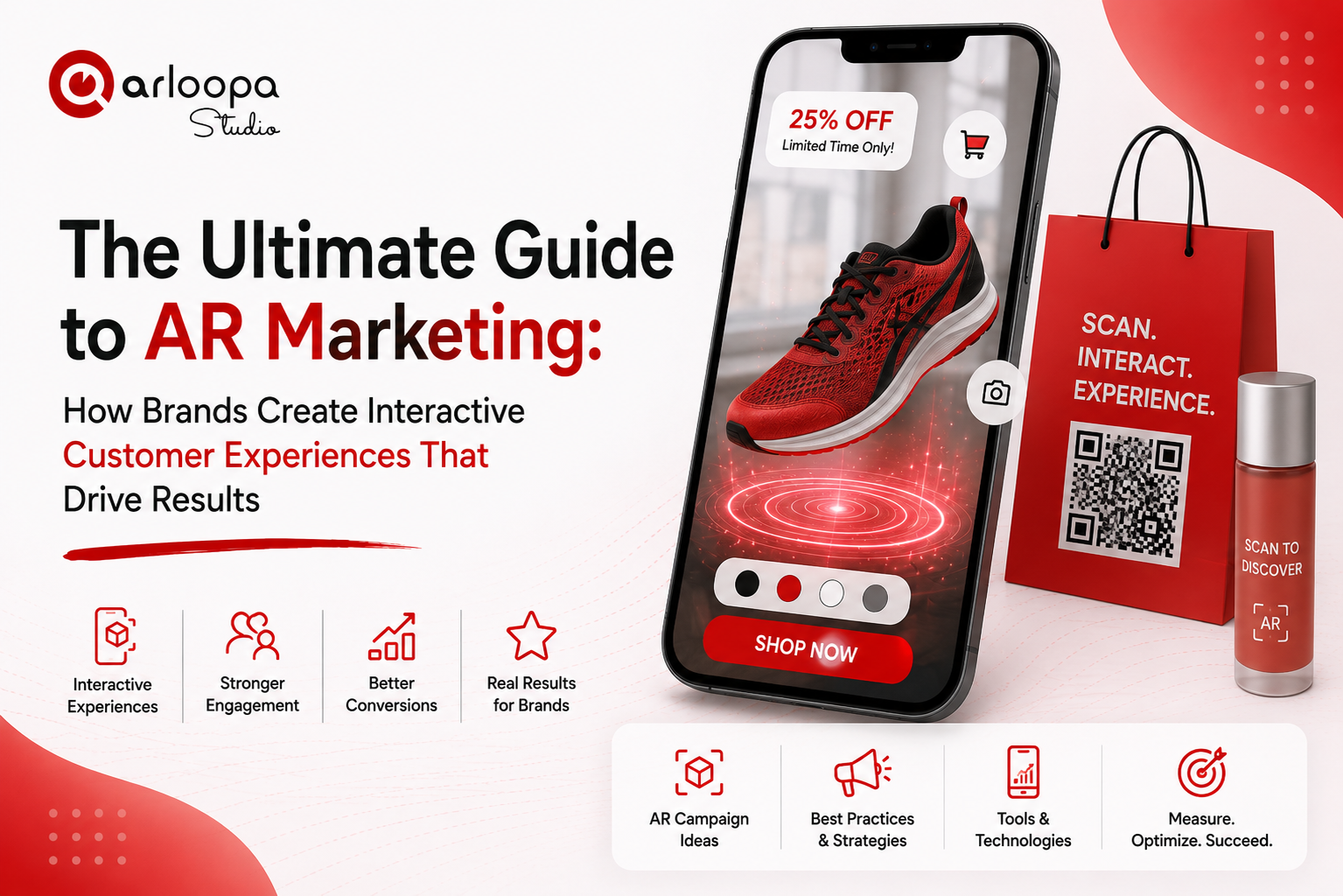
Marketing has evolved far beyond static advertisements and traditional digital campaigns. Today's consumers expect experiences that are interactive, personalized, and memorable. They want to engage with brands - not just observe them.
This is where augmented reality (AR) marketing is changing the game.
From trying on products virtually to scanning packaging that unlocks exclusive content, AR transforms everyday interactions into immersive brand experiences. Businesses across retail, tourism, real estate, education, manufacturing, and entertainment are using AR to capture attention, increase engagement, and influence purchasing decisions.
In this ultimate guide, you'll learn what AR marketing is, why it works, and how your business can create successful AR campaigns.
What Is AR Marketing?
AR marketing is the use of augmented reality technology to enhance marketing campaigns by overlaying digital content - such as 3D models, animations, videos, games, and interactive information - onto the real world.
Using a smartphone, tablet, or AR glasses, customers can interact with digital experiences tied to physical products, printed materials, packaging, or real-world locations.
Unlike traditional advertising, AR invites users to actively participate rather than passively consume content.
Examples include:
- Scanning product packaging to reveal interactive animations.
- Virtually placing furniture in a living room before buying.
- Exploring a 3D model of a new product.
- Participating in an AR treasure hunt around a city.
- Unlocking exclusive content through product labels.
- Trying on cosmetics, glasses, or accessories virtually.
These experiences create stronger emotional connections and make brands more memorable.
Why AR Marketing Works
Consumers are exposed to thousands of advertisements every day. Standing out requires more than eye-catching visuals - it requires interaction.
AR marketing succeeds because it encourages people to engage directly with content instead of simply viewing it.
Some of the biggest advantages include:
- Higher customer engagement
- Longer interaction times
- Better brand recall
- Increased purchase confidence
- More social media sharing
- Improved customer satisfaction
- Reduced product uncertainty
Interactive experiences naturally attract attention and encourage exploration.
Benefits of Augmented Reality Marketing
1. Increase Customer Engagement
One of AR's greatest strengths is its ability to transform passive audiences into active participants.
Instead of watching an advertisement, customers can:
- Explore products in 3D
- Play branded mini-games
- Watch interactive demonstrations
- Discover hidden digital content
- Complete challenges and earn rewards
The longer customers interact with a brand, the stronger the connection becomes.
2. Improve Product Understanding
Many products are difficult to explain through photos alone.
AR allows customers to:
- View products from every angle
- Explore features interactively
- Watch demonstrations
- See products at real scale
- Understand complex functionality
This helps customers make more informed purchasing decisions.
3. Boost Sales
Interactive experiences reduce uncertainty.
When customers can visualize products in their own environment or understand how they work, they're more likely to complete a purchase.
This is especially valuable for products that involve customization, assembly, or higher price points.
4. Create Memorable Brand Experiences
People remember experiences far more than advertisements.
Whether it's an interactive billboard, an AR product launch, or a gamified campaign, immersive experiences leave lasting impressions that increase brand recognition.
5. Encourage Social Sharing
Unique AR experiences often inspire users to share screenshots, videos, and reactions on social media.
This creates valuable user-generated content and expands campaign reach organically.
Popular Types of AR Marketing Campaigns
Interactive Product Packaging
Packaging becomes a digital gateway.
Customers scan a product to unlock:
- Product stories
- How-to videos
- Recipes
- Brand history
- Loyalty rewards
- Games
- Promotional offers
This transforms packaging into an ongoing communication channel.
Virtual Product Visualization
Allow customers to preview products before purchasing.
Popular applications include:
- Furniture
- Home décor
- Electronics
- Fashion
- Art
- Appliances
Seeing products in real environments increases purchasing confidence.
Virtual Try-On Experiences
Fashion and beauty brands use AR to let customers virtually try:
- Glasses
- Makeup
- Jewelry
- Hats
- Shoes
- Watches
Customers gain confidence without visiting a physical store.
Interactive Print Advertising
Printed materials become interactive when scanned.
Examples include:
- Magazines
- Flyers
- Brochures
- Business cards
- Posters
- Catalogs
AR extends the life and value of traditional print marketing.
Geospatial AR Campaigns
Brands create location-based experiences that encourage customers to explore physical locations.
Examples include:
- Treasure hunts
- Product launches
- Tourism experiences
- Festival activities
- City-wide promotions
Location-based AR combines digital engagement with real-world exploration.
Event Marketing
AR enhances conferences, exhibitions, and trade shows through:
- Interactive booths
- Digital product demonstrations
- Gamified networking
- Wayfinding
- Sponsor activations
- Photo experiences
Visitors stay engaged while learning more about the brand.
Industries Using AR Marketing
Retail
Retailers use AR for virtual shopping, product demonstrations, and interactive catalogs.
Food and Beverage
Brands enhance packaging with recipes, promotions, storytelling, and games.
Tourism
Tourism organizations create AR walking tours, historical reconstructions, and interactive travel guides.
Real Estate
Property developers offer virtual property tours and interactive architectural visualizations.
Automotive
Manufacturers showcase vehicle features, customization options, and maintenance guidance using AR.
Education
Educational institutions use AR to attract prospective students and enhance learning experiences through interactive marketing campaigns.
Building an Effective AR Marketing Strategy
A successful campaign starts with clear objectives.
Ask yourself:
- What action do you want users to take?
- Who is your target audience?
- Which devices will your audience use?
- Where will people access the experience?
- How will success be measured?
Every AR experience should support a broader marketing goal rather than exist simply because the technology is available.
Best Practices for AR Marketing
To maximize results:
- Keep experiences simple and intuitive.
- Deliver value within the first few seconds.
- Focus on storytelling rather than technology.
- Optimize content for mobile devices.
- Use high-quality 3D models and animations.
- Include clear calls to action.
- Encourage sharing and repeat engagement.
- Test across multiple devices before launch.
The best AR experiences solve a problem, entertain users, or provide useful information.
Creating AR Marketing Campaigns with ARLOOPA Studio
You don't need a team of developers to launch an immersive marketing campaign.
With ARLOOPA Studio, businesses, agencies, and creators can build interactive AR experiences using a no-code visual editor.
Key capabilities include:
- Image Tracking to bring product packaging, brochures, posters, business cards, and advertisements to life.
- Surface Tracking to place products in customers' real environments for interactive visualization.
- Geospatial AR for location-based campaigns, city activations, and outdoor brand experiences.
- WebAR to allow customers to launch experiences directly from a web browser - no app download required.
- AI-powered 3D model generation to accelerate content creation and reduce production time.
- Support for videos, audio, animations, PDFs, interactive buttons, forms, and rich multimedia content.
Whether you're promoting a product launch, creating an interactive catalog, enhancing packaging, or designing a large-scale brand activation, ARLOOPA Studio helps turn creative ideas into immersive customer experiences.
Start Creating Immersive Marketing Experiences
Whether you're a startup, global brand, marketing agency, retailer, museum, tourism organization, or educational institution, AR can help you capture attention, increase engagement, and create unforgettable customer experiences.
With ARLOOPA Studio, you can design and publish interactive AR marketing campaigns without coding - bringing your ideas to life through Image Tracking, Surface Tracking, Geospatial AR, WebAR, AI-generated 3D content, and more.
The next generation of marketing isn't just digital - it's interactive.


See more articles



Solutions