
 Augmented Reality in Education: Why AR Should Enhance and Not Replace the Traditional Teaching
Augmented Reality in Education: Why AR Should Enhance and Not Replace the Traditional Teaching
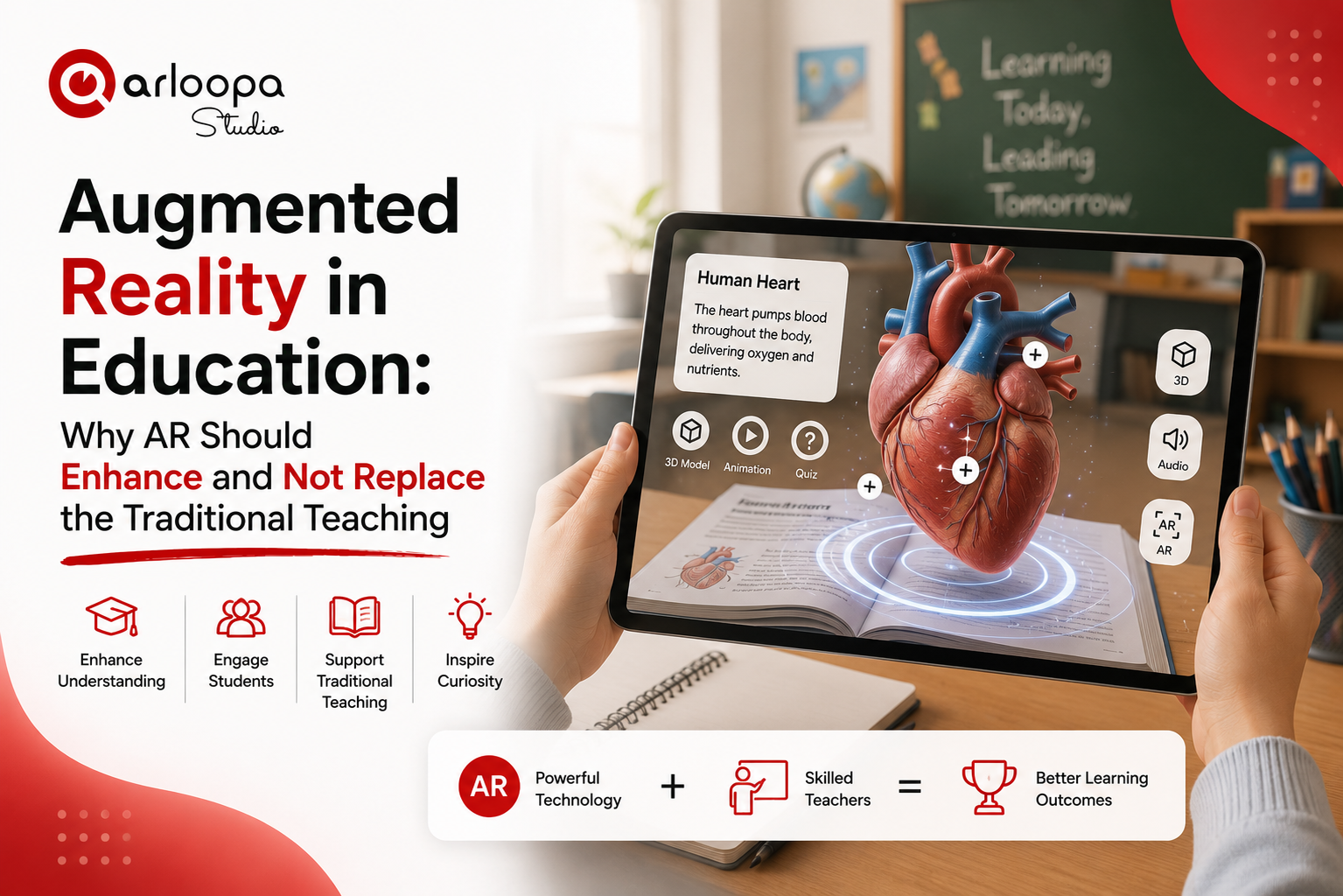
Technology has transformed nearly every aspect of education, from online learning platforms to AI-powered tutoring. Among these innovations, augmented reality (AR) has emerged as one of the most exciting tools for creating interactive and engaging learning experiences.
But as schools adopt new technologies, one important question remains:
Can AR replace traditional teaching?
The answer is simple: No - and it shouldn't.
The greatest strength of augmented reality isn't replacing teachers, textbooks, or classroom discussions. It's enhancing them. When used thoughtfully, AR complements traditional teaching methods by making abstract concepts easier to understand, encouraging active participation, and creating memorable learning experiences.
In this article, we'll explore why AR is most effective as a teaching enhancement and how educators can successfully integrate it into their classrooms.
What Is Augmented Reality in Education?
Augmented reality overlays digital content - such as 3D models, animations, videos, and interactive information - onto the real world through a smartphone, tablet, or AR headset.
Instead of replacing physical learning materials, AR adds an extra layer of information and interaction.
For example, students can:
- Scan a textbook page to reveal a rotating 3D model.
- Explore the solar system from their classroom desk.
- Examine the human heart layer by layer.
- Watch historical monuments reconstructed in their original form.
- Interact with scientific experiments that would otherwise be impossible to perform in class.
AR makes learning more visual, interactive, and immersive without changing the teacher's role as the guide and facilitator.
Why Traditional Teaching Still Matters
Technology is a powerful educational tool, but great teaching goes beyond delivering information.
Teachers provide:
- Personalized guidance
- Critical thinking exercises
- Classroom discussions
- Emotional support
- Real-time feedback
- Adaptation to different learning styles
These human elements cannot be replaced by technology.
A textbook may explain a concept, and an AR model may help students visualize it, but it's the teacher who connects both to meaningful learning.
The most effective classrooms combine the strengths of traditional instruction with the possibilities of digital technology.
How AR Enhances Traditional Teaching
1. Making Abstract Concepts Easy to Visualize
Many subjects involve ideas that students struggle to imagine.
AR helps bring these concepts into the real world.
For example:
- Biology students can explore organs and cells in 3D.
- Chemistry students can examine molecular structures.
- Mathematics students can manipulate geometric shapes.
- Geography students can interact with landscapes and topography.
Instead of replacing explanations, AR reinforces them through visualization.
2. Increasing Student Engagement
Students are naturally curious when lessons become interactive.
AR encourages learners to:
- Explore
- Ask questions
- Collaborate with classmates
- Solve problems
- Participate actively
Rather than passively listening, students become active participants in the learning process.
Teachers remain at the center of the lesson while AR supports engagement.
3. Supporting Different Learning Styles
Every classroom includes students who learn differently.
Some understand concepts best through reading, while others benefit from seeing, hearing, or interacting with content.
AR combines multiple learning approaches by integrating:
- Visual models
- Audio narration
- Interactive exploration
- Text explanations
- Videos
- Animations
This helps teachers reach a wider range of learners without changing their teaching style.
4. Bringing Textbooks to Life
Printed textbooks remain valuable educational resources, but they often have limitations when explaining dynamic or three-dimensional concepts.
Using Image Tracking, teachers can transform textbook pages into interactive experiences.
Students simply scan a page to access:
- Animated diagrams
- Interactive 3D models
- Educational videos
- Additional learning resources
- Voice explanations
Instead of replacing textbooks, AR expands their educational value.
5. Encouraging Active Learning
Research consistently shows that students learn more effectively when they actively participate rather than simply observe.
AR encourages students to:
- Explore concepts independently
- Experiment safely
- Solve challenges
- Discover information through interaction
Teachers can then guide discussions, answer questions, and deepen understanding based on students' experiences.
Practical Ways Teachers Can Use AR
AR works best when integrated into existing lesson plans rather than treated as a separate activity.
Here are a few examples:
Science
Students examine 3D models of the human body, plants, or planets after the teacher introduces the topic.
History
Learners scan historical images to view reconstructed buildings, artifacts, or historical events in augmented reality.
Mathematics
Students manipulate geometric figures while discussing formulas and properties with their teacher.
Geography
Maps become interactive, allowing students to explore terrain, landmarks, and climate zones.
Language Learning
Vocabulary cards reveal 3D objects, pronunciation guides, and example sentences through AR.
In each case, the teacher provides context while AR enhances understanding.
Building Interactive Lessons with ARLOOPA Studio
Creating educational AR experiences doesn't require programming skills.
With ARLOOPA Studio, teachers and educational institutions can build interactive lessons using a no-code visual editor.
Educators can:
- Transform textbook pages into interactive learning materials with Image Tracking.
- Place 3D educational models directly into the classroom using Surface Tracking.
- Create outdoor learning activities with Geospatial AR.
- Share lessons through WebAR, allowing students to access content directly from a browser.
- Generate educational 3D models using AI to save time creating classroom resources.
By combining traditional teaching methods with immersive technology, ARLOOPA Studio helps educators create engaging learning experiences while keeping teachers at the heart of the classroom.
Best Practices for Combining AR and Traditional Teaching
To get the most from augmented reality:
- Begin with clear learning objectives.
- Introduce the concept before launching the AR experience.
- Encourage discussion during and after the activity.
- Use AR to explain concepts that are difficult to visualize.
- Keep experiences simple and relevant.
- Allow students time to reflect on what they learned.
- Evaluate learning outcomes—not just technology use.
The goal is not to replace traditional teaching but to make it more effective.
Bring Your Lessons to Life with ARLOOPA Studio
Whether you're teaching science, history, geography, mathematics, languages, or vocational skills, ARLOOPA Studio makes it easy to create interactive AR experiences without coding.
With features like Image Tracking, Surface Tracking, Geospatial AR, WebAR, multimedia support, and AI-powered 3D model generation, educators can enrich traditional lessons and inspire students to explore, discover, and learn in entirely new ways.


See more articles



Solutions