
 Why Businesses Should Prepare for AR Glasses: The Next Evolution of Customer Experience
Why Businesses Should Prepare for AR Glasses: The Next Evolution of Customer Experience
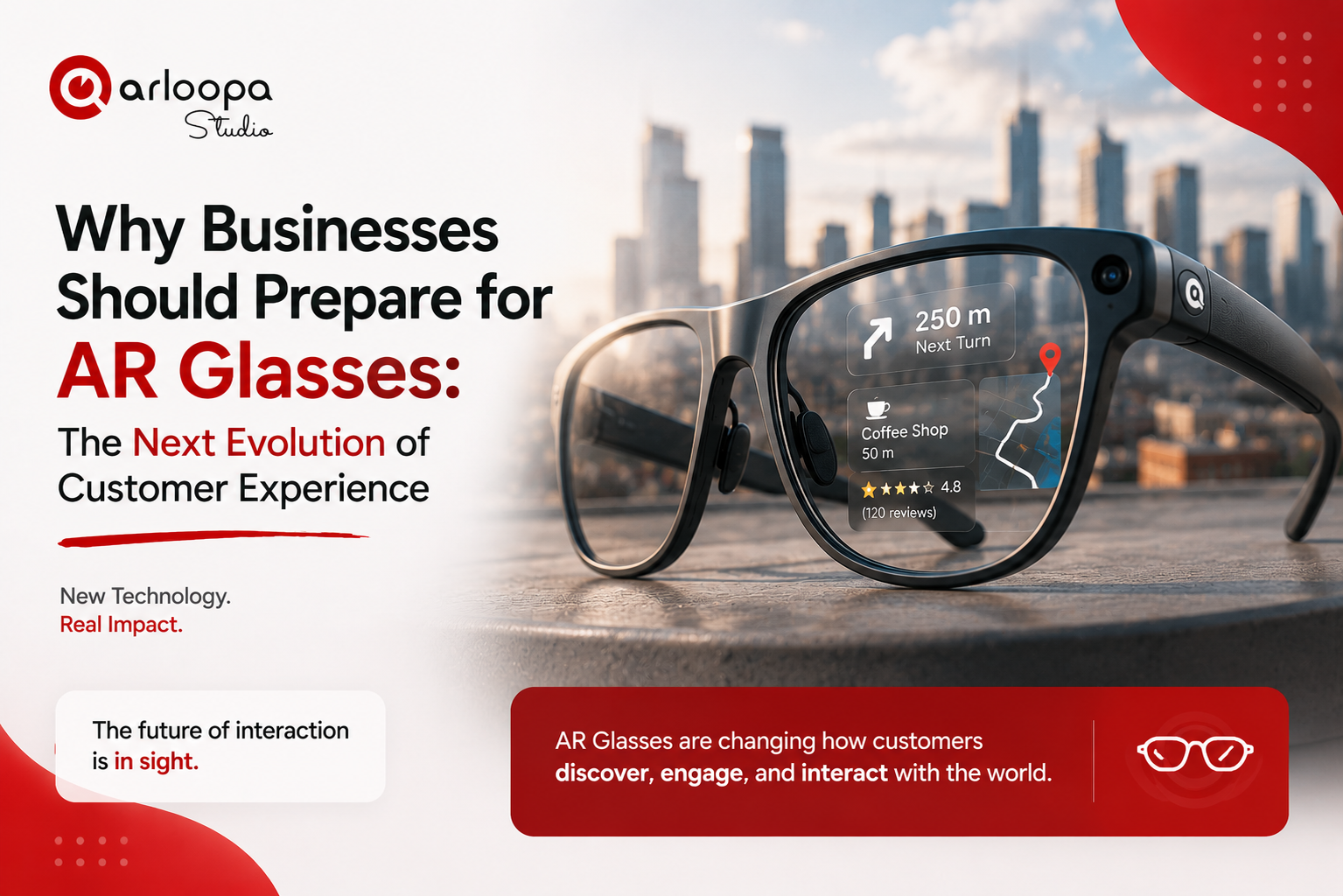
For years, augmented reality has primarily been experienced through smartphones and tablets. These devices introduced millions of people to interactive digital experiences, from virtual product previews to immersive educational content.
But the next major shift in augmented reality is already underway.
AR glasses are expected to make digital content a natural part of our everyday lives, allowing users to see information, navigation, instructions, and interactive experiences directly within their field of view - without constantly holding a phone.
While widespread consumer adoption will take time, forward-thinking businesses have an opportunity to prepare now. Companies that begin building AR-ready content today will be well positioned as wearable technology becomes more common.
The question is no longer if AR glasses will become part of business workflows—it's how prepared your business will be when they do.
What Are AR Glasses?
AR glasses are wearable devices that overlay digital information onto the real world while allowing users to remain aware of their surroundings.
Unlike virtual reality headsets, which replace the user's environment with a fully digital one, AR glasses blend physical and digital content together.
Depending on the device, users may see:
- 3D products
- Navigation directions
- Interactive instructions
- Notifications
- Digital labels
- Live data
- Educational content
- Remote collaboration tools
The experience is designed to feel seamless, making digital information available exactly when and where it's needed.
Why AR Glasses Matter for Businesses
The transition from smartphones to wearable AR represents more than a new device - it changes how customers and employees interact with digital information.
Instead of opening an app, users can access information instantly while continuing their current activity.
For businesses, this means creating experiences that are:
- More natural
- More accessible
- More contextual
- More immersive
- More efficient
Companies that already use augmented reality will have a significant advantage because much of their existing content can be adapted for future wearable devices.
Industries That Will Benefit from AR Glasses
Retail
Imagine customers walking through a store while AR glasses display:
- Product information
- Reviews
- Personalized recommendations
- Available sizes
- Promotions
- Navigation to specific items
Shopping becomes more informative without requiring customers to use their phones.
Manufacturing
Factory workers can receive real-time instructions while keeping both hands free.
AR glasses can display:
- Assembly guidance
- Equipment status
- Safety alerts
- Maintenance procedures
- Live performance data
This can improve efficiency while reducing errors.
Field Service and Maintenance
Technicians repairing equipment can view step-by-step instructions directly in front of them.
Instead of stopping to read manuals, they receive contextual guidance exactly when needed.
This shortens repair times and improves accuracy.
Healthcare
Medical professionals can access patient information, anatomical references, and procedural guidance without leaving the patient.
Hands-free access to information can improve workflow while allowing healthcare teams to remain focused on care.
Education
Students can interact with educational content naturally while participating in classroom activities.
Teachers can present:
- 3D scientific models
- Historical reconstructions
- Engineering demonstrations
- Language-learning activities
Rather than replacing traditional instruction, AR glasses make learning more immersive.
Tourism and Museums
Visitors can experience locations in entirely new ways.
AR glasses could display:
- Historical reconstructions
- Virtual tour guides
- Multilingual information
- Interactive storytelling
- Navigation through exhibitions
Digital experiences become integrated into the physical environment.
Why Businesses Should Start Preparing Today
Content Takes Time to Create
One of the biggest misconceptions is that businesses should wait until AR glasses become mainstream.
In reality, creating high-quality AR content requires planning, testing, and iteration.
Organizations that begin developing immersive experiences today will have a valuable content library ready for future devices.
Customer Expectations Are Already Changing
Consumers increasingly expect interactive experiences.
Many already engage with:
- Virtual product previews
- AR filters
- Interactive packaging
- Digital maps
- Product visualization
AR glasses simply make these experiences more convenient and immersive.
Preparing now means staying ahead of customer expectations.
Your Existing AR Content Can Evolve
Businesses that invest in AR today aren't starting from scratch when wearable devices become more widespread.
Content created for smartphones and tablets - such as 3D models, animations, and interactive experiences - can often be adapted and expanded for future AR platforms.
That makes today's investment valuable beyond current campaigns.
Practical Ways to Prepare for AR Glasses
You don't need to wait for widespread adoption to begin planning.
Here are practical steps your business can take today:
Build a Library of 3D Assets
High-quality 3D models will be essential for future AR experiences.
Develop a consistent collection of products, environments, and branded assets that can be reused across different platforms.
Experiment with Interactive Experiences
Start creating AR experiences for mobile devices.
This helps your team understand:
- User interaction
- Content design
- Performance optimization
- Storytelling in augmented reality
These skills will remain valuable as new devices emerge.
Focus on User Experience
Successful AR experiences aren't defined by technology - they're defined by usability.
Create experiences that are:
- Simple
- Fast
- Intuitive
- Helpful
- Context-aware
Great user experience will remain important regardless of device.
Train Your Team
Encourage designers, marketers, educators, and developers to become familiar with AR workflows now.
Organizations that build internal expertise today will adapt more quickly tomorrow.
Creating Future-Ready AR Content with ARLOOPA Studio
Preparing for AR glasses starts with creating immersive content that can evolve alongside emerging technology.
With ARLOOPA Studio, businesses can build interactive AR experiences without coding while developing reusable digital assets for future platforms.
Key capabilities include:
- Image Tracking for interactive packaging, brochures, and printed materials.
- Surface Tracking to place products and digital content in real-world environments.
- Geospatial AR for location-based experiences, tourism, and outdoor campaigns.
- WebAR to make AR accessible directly through a browser.
- AI-powered 3D model generation to accelerate content creation.
- Support for animations, videos, audio, interactive buttons, forms, and multimedia experiences.
By creating AR experiences today, organizations can establish workflows, develop content libraries, and gain practical experience that will support future wearable AR devices


See more articles



Solutions