



 What Makes an AR Campaign Successful
What Makes an AR Campaign Successful
Augmented reality can turn a simple campaign into something people actively explore, remember, and share. But strong AR campaigns are not built just by adding impressive visuals. They work when the experience is easy to access, clearly connected to the message, and designed for the real way people interact with content.
A successful AR campaign is not about doing everything. It is about doing the right thing in the right context.
Start With a Clear Purpose
Before creating any AR experience, define what the campaign is meant to achieve.
Some campaigns are built to attract attention. Others are created to help people discover more about a product, interact with printed materials, explore a place, or experience a brand in a more memorable way.
When the goal is clear, the campaign becomes easier to shape. The visuals, content, format, and messaging all become more focused.
AR works best when it supports a real objective instead of being added as a trend-driven extra.
Choose the Right Type of Experience
Not every AR campaign should work the same way. The format should match the campaign idea.
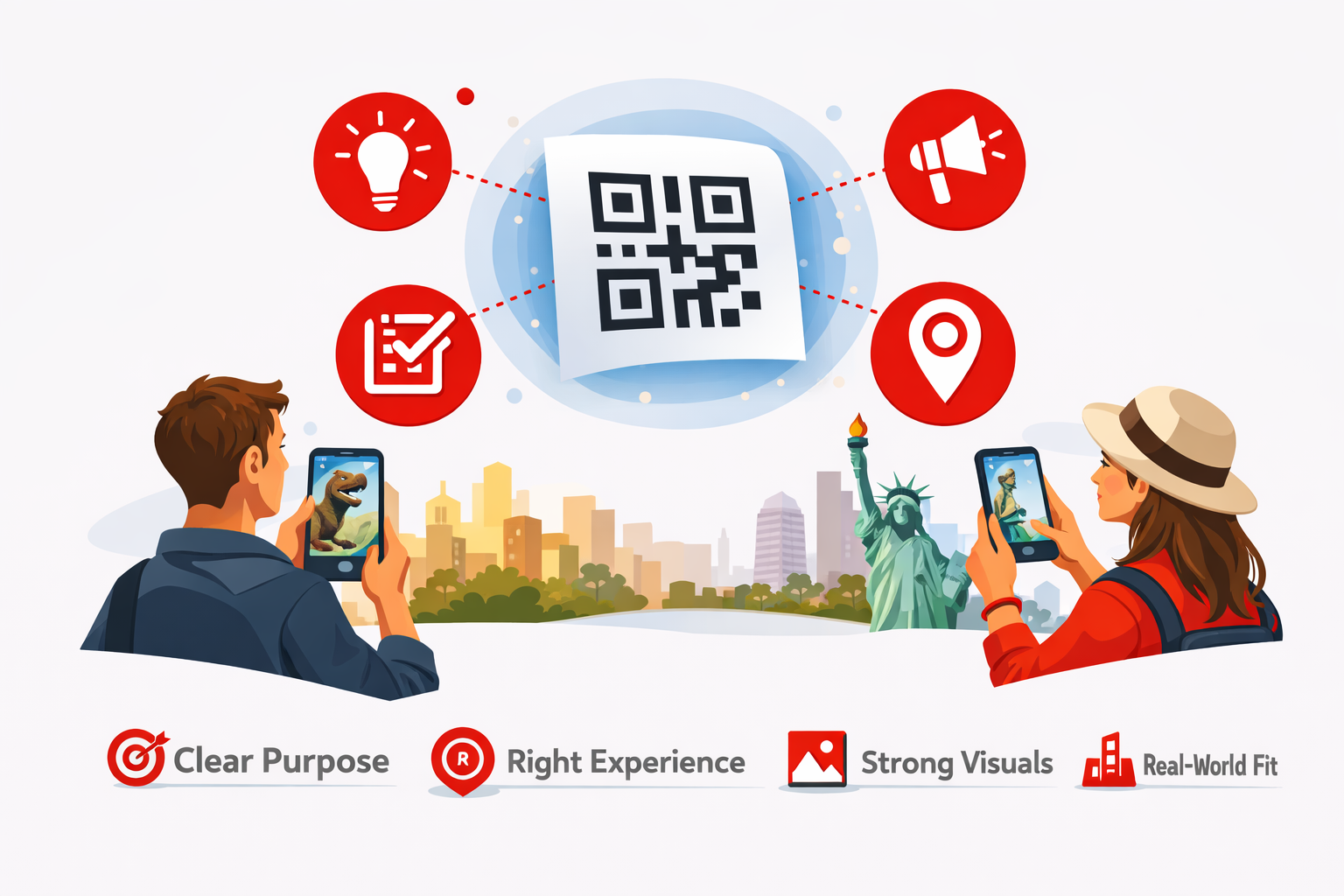
If the experience is connected to packaging, posters, flyers, books, menus, or printed visuals, marker-based AR can be a strong choice. It helps transform a static image into something interactive and engaging.
If the campaign is tied to a physical destination, event, store, public space, museum, campus, or tourism route, location-based AR may be more effective. It allows digital content to appear in specific real-world places and creates a stronger connection between content and location.
In ARLOOPA Studio, choosing the right format from the start helps keep the campaign more natural and more effective.
Make It Easy to Understand
One of the most common reasons AR campaigns underperform is simple: people do not immediately understand what they are supposed to do.
The campaign should make the next step obvious. Users should quickly understand:
where to point their device
what will happen
why it is worth trying
Good AR campaigns remove hesitation. A user should not need to guess how the experience works.
The easier the first interaction feels, the more likely people are to continue.
Give the Audience a Real Reason to Engage
AR should add value, not just movement.
That value might come through storytelling, product presentation, visual transformation, education, immersion, or surprise. The important thing is that the AR experience gives the audience something meaningful beyond the original printed material or physical location.
A good campaign answers this question clearly:
Why is this better with AR than without it?
If the AR layer helps people see more, understand more, or experience something in a more memorable way, it becomes much more powerful.
Keep the Experience Focused
A successful AR campaign does not need to be overloaded.
In many cases, a simpler experience performs better because it gets to the point faster. One strong visual idea, one clear message, and one satisfying interaction can be more effective than trying to include too much.
People usually engage with campaigns quickly, especially in public or mobile environments. That is why clarity matters more than complexity.
A focused AR campaign is often easier to launch, easier to understand, and more enjoyable to use.
Design for the Real Environment
AR campaigns live in real places, not controlled presentations.
That means it is important to think about how and where people will access the experience. Are they indoors or outdoors? Standing still or moving? Looking at a product, a poster, a package, or a location? Are they at an event, in a shop, or in a public area?
The campaign should fit the setting where it appears.
For example, a marker-based experience on packaging should be quick and visually clear. A location-based experience in a public area should feel relevant to that place. The more naturally the campaign fits its environment, the stronger the result tends to be.
Strong Visuals Make a Big Difference
AR is visual by nature, so the content itself matters a lot.
The experience should feel aligned with the brand, message, and campaign mood. Whether the content is playful, informative, premium, educational, or promotional, it should look intentional and well connected to the original campaign asset.
With ARLOOPA Studio, creators can build experiences using their own content and also use AI tools to generate assets such as models, images, audio, and videos more quickly. That can help speed up production and make it easier to turn an idea into a finished campaign.
But even with faster tools, strong creative direction still matters. The campaign should look like it belongs to the brand and the audience it is trying to reach.
Think Beyond the AR Itself
Even a good AR experience needs support around it.
People need to notice it first. That means the campaign should also communicate clearly outside the AR layer. Printed instructions, social promotion, event messaging, packaging design, or visual prompts can all help guide people into the experience.
If the campaign is hard to notice or poorly introduced, many users may never try it at all.
Successful AR campaigns are not only well made. They are also well presented.
Test Before Launching
Before launching, it is worth checking how the campaign feels in real use.
Does the marker work clearly? Is the printed visual easy to scan? Does the experience feel smooth and understandable? Does it look strong on a mobile device? Does the campaign still make sense in the actual place where users will discover it?
These kinds of checks can make a big difference.
Sometimes the most important improvements are not major changes. They are small adjustments that make the campaign easier to use and more enjoyable to experience.
Build Around the Audience, Not Just the Technology
The best AR campaigns feel relevant because they are built around people.
They respect the user’s time, attention, and environment. They are easy to start, visually rewarding, and closely tied to the purpose of the campaign.
That is where AR becomes more than a technical feature. It becomes a better way to communicate, present, and engage.
With ARLOOPA Studio, creators can build marker-based and location-based experiences that connect digital content to the physical world in a practical and creative way. When the idea is clear and the experience is designed well, AR can make a campaign feel more alive and much more memorable.
Final Thoughts
A successful AR campaign is not necessarily the most complex one. It is the one that feels clear, useful, and engaging from the very first interaction.
Start with a real goal. Choose the right format. Keep the experience simple. Make it visually strong. Design for the real environment. And give people a reason to care.
That is what helps AR campaigns work.


See more articles



Solutions